
After spending 178 days aboard the International Space Station in 2011, astronaut Ron Garan returned to Earth carrying something far heavier than space equipment or mission data. He returned with a transformed understanding of humanity itself.
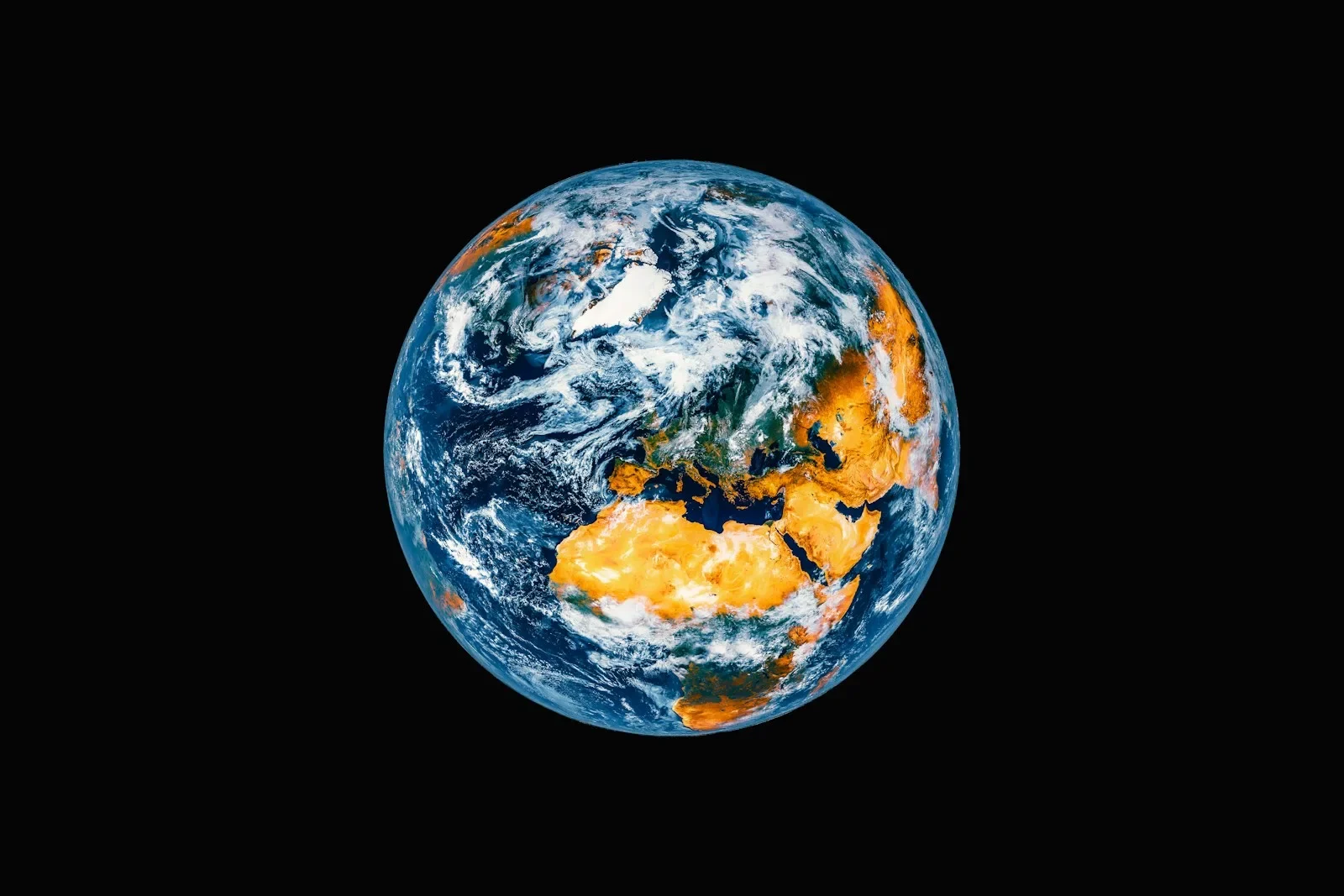
From orbit, Earth doesn’t look like a collection of countries, borders, or competing interests. It appears as a single, radiant blue sphere suspended in darkness. No lines divide continents. No flags mark territory. From 250 miles above the surface, every human conflict suddenly looks small — and every human connection looks unavoidable.
Garan described watching lightning storms crackle across entire continents, auroras ripple like living curtains over the poles, and city lights glow softly against the planet’s night side.
What struck him most wasn’t Earth’s power — it was its fragility. The atmosphere protecting all life appeared as a paper-thin blue halo, barely visible, yet responsible for everything that breathes, grows, and survives.
That view triggered what astronauts call the “overview effect” — a profound cognitive shift reported by many who see Earth from space. It’s the sudden realization that humanity shares a single, closed system. No backups. No escape route. No second home.
Garan began questioning humanity’s priorities. On Earth, economic growth is often treated as the ultimate goal. From space, that hierarchy collapses. He argues that the correct order should be planet first, society second, economy last — because without a healthy planet, neither society nor an economy can exist.
He often compares Earth to a spacecraft. A ship carrying billions of crew members, all dependent on the same life-support systems. And yet, many behave as passengers rather than caretakers, assuming someone else is responsible for keeping things running.
From orbit, pollution has no nationality. Climate systems ignore borders. Environmental damage in one region ripples across the entire globe. The divisions we defend so fiercely on the ground simply don’t exist from above.
Garan’s message isn’t abstract or idealistic. It’s practical. If humanity continues to treat Earth as an unlimited resource rather than a shared system, the consequences will be universal.
Seeing Earth from space didn’t make him feel small. It made him feel accountable.
Because when you truly understand that we’re all riding the same fragile spacecraft through the universe, the idea of “us versus them” quietly disappears — replaced by a single, unavoidable truth: There is only us.
Neil deGrasse Tyson
My Commentary:
There Is Only Us
Perhaps astronauts see from space what God has always seen from heaven: one human family living together on one beautiful, fragile Earth.
From 250 miles above us, there are no visible national borders. There are no lines separating rich from poor, Christian from Muslim, conservative from liberal, friend from enemy. There is simply one blue planet carrying all God’s children.
Scripture begins by telling us that creation is God’s handiwork and that humanity was entrusted with its care. We were never given ownership without responsibility. We were given stewardship.
Jesus constantly challenged the boundaries people constructed between themselves. He made a Samaritan the hero of a parable. He touched lepers. He welcomed foreigners. He ate with outcasts. Again and again, He enlarged the meaning of the word neighbor.
The view from space asks us to do the same.
We can disagree about politics, economics, borders, and the best ways to protect our environment. But beneath those disagreements lies the deepest teaching of Jesus: we belong to one another.
The atmosphere protecting one nation protects every nation. The oceans touching one shore eventually touch another. And the God who created me created the person on the other side of every border.
Ron Garan returned from space feeling accountable.
Perhaps that is the spiritual lesson.
God gave us an extraordinary home — and one another.
There is no “them” in the family of God.
There is only us.
Do YOU feel the same way I do? The only way we are going to solve our problems on earth is to have everyone on earth dramatically change their perspective. All 8.3 billion of us need to go into space and behold the Blue Pearl floating 250 miles in the distance. We all need to open our eyes and see what God sees! What are YOUR thoughts?
GOD HAS A WAY OF REVEALING THINGS TO YOU. PAY ATTENTION!!
Are you feeling like I am these days? That it felt more like America a couple of years ago than it does today? This is why I wrote the book — WHAT MAKES AMERICA AMERICA.
I have 62 short Chapters on everything from Football to Affordability. Here is the link https://a.co/d/00Lyqe1C that will connect you with my Amazon page. Click READ SAMPLE and you can read the first few Chapters of my book for FREE.
