
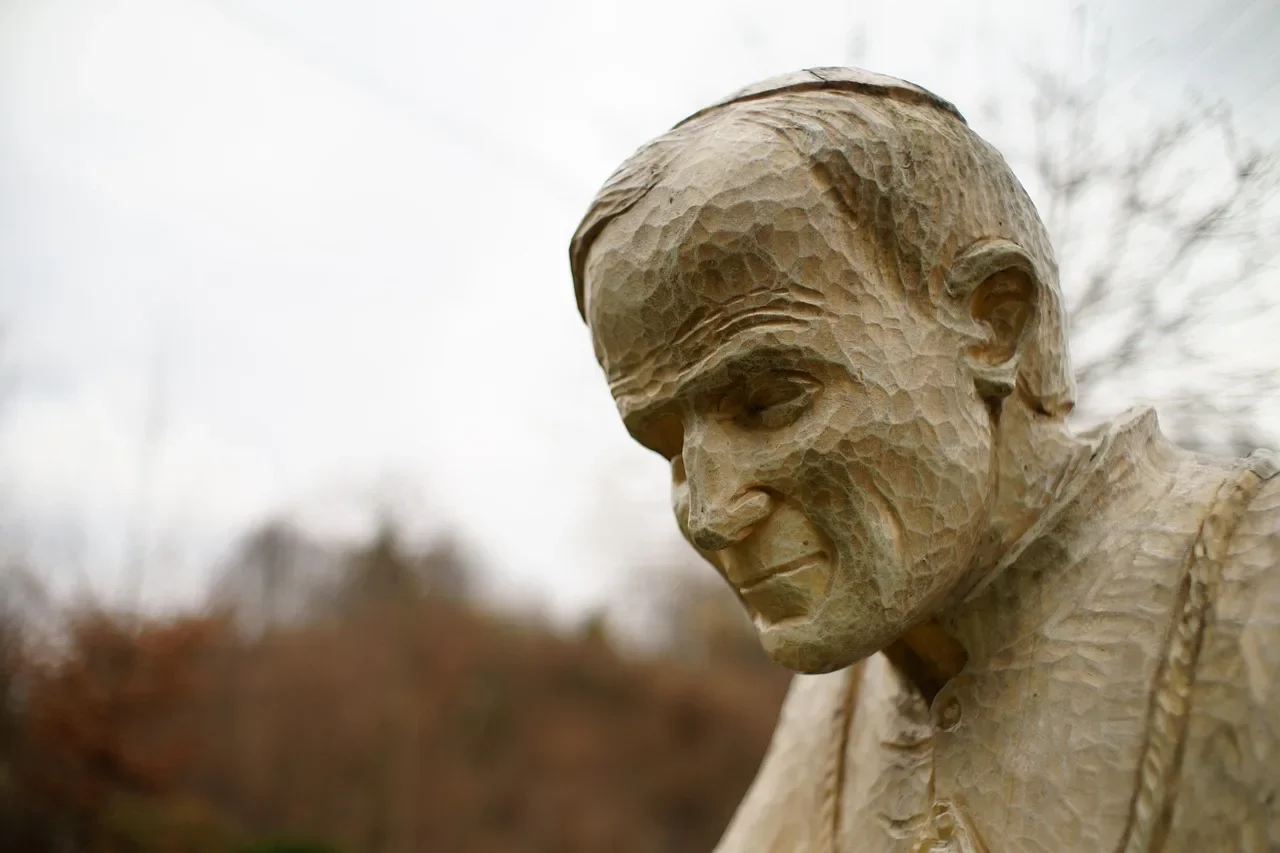
Look at Pope John Paul II toward the end of his life. That image of him sitting slumped over in his rolling throne (the Vatican would never call it a “wheelchair”), his eyes either closed or almost, his face contorted. Was it pain, anxiety, or a crushing sense of so much still to do?
In the end, Karol Wojtyla, deeper than his politics and beyond his early 20th century Polish Catholic cultural formation, was a mensch. He was a strong, intelligent, committed human being, someone whose integrity and dedication represent a standard by which other leaders can be measured.
John Paul was a selfless figure in a me-first world. Cardinal Roberto Tucci, who planned John Paul’s voyages before retiring in 2001, once said he had briefed John Paul hundreds of times on the details for his various trips. Not once, Tucci said, did the pope ever ask where he was going to sleep, what he would eat or wear, or what his creature comforts would be. The same indifference to himself could be seen every time the pope stepped, or, in the end, was rolled upon the public stage.
This is the key that unlocks why John Paul drew enormous crowds, even where his specific political or doctrinal stands may be unpopular. It’s a rare ideologue for whom condoms or the Latin Mass represent ultimate concerns. Deeper than politics, either secular or ecclesiastical, lies the realm of personal integrity — goodness and holiness, the qualities we prize most in colleagues, family and friends. A person may be liberal or conservative, avant-garde or traditional, but let him or her be decent and most of the time that’s enough.
This realm of menschlichkeit, authentic humanity, is where John Paul’s appeal came from. For a pope of a hundred trips and a million words, perhaps the most important lesson he offered was the coherence of his own life. When he urged Christians to Duc in Altum, to set off into the deep, it resonated even with those who sought very different shores.
He was part of all our lives, but he would not let us be part of his. He was seen, heard but not fully understood. Admired, not always liked. Outside the church, the democrat. Inside the church, the autocrat.
Karol Wojtyla, motherless boy, proud, confident priest, controlling pope and fearless world leader in death challenges history to describe who he was and what he did.
He was a formidable pope. It will be a formidable task.
By John Allen 2005 National Catholic Reporter John L. Allen Jr. (1965 – 2026) was an American journalist and author who served as editor of the Catholic website Crux. Allen worked for 17 years covering the Holy See and the Pope for National Catholic Reporter and Crux. He is dearly missed by many.
My Commentary:
Toward the end of his life, Saint John Paul II presented the world with a very different image of leadership. The vigorous pope who had traveled the globe, confronted communism, spoken to millions, and commanded enormous crowds became frail, stooped, trembling, and increasingly dependent upon others.
Yet somehow, he did not seem smaller. Perhaps he became greater.
John Paul II taught many things through speeches and encyclicals, but one of his final sermons was delivered without words. He allowed the world to see his weakness. In a culture that often hides aging, disability, and suffering, he showed that human dignity does not disappear when human strength does.
He was certainly a complicated leader. People disagreed with him — sometimes strongly — about decisions he made and positions he defended. History can acknowledge those disagreements while still recognizing something extraordinary about the man: his life possessed a remarkable sense of purpose and integrity.
Cardinal Tucci’s observation is revealing. Saint John Paul traveled constantly, yet apparently showed little concern about where he would sleep, what he would eat, or how comfortable he would be. His attention was elsewhere.
Jesus said, “Whoever wishes to be great among you must be your servant.”
That may explain much of John Paul’s appeal. People sensed that beneath the robes, titles, theology, and authority was a man who had given his life to something greater than himself. His final years asked a question of every leader: When the applause disappears, the strength fades, and the title no longer matters, what remains?
For John Paul II, what remained was faith, courage, perseverance, and the dignity of a life given in service.
Perhaps that is the final measure of leadership — and of life.
Do YOU believe that every leader in today’s world asks himself or herself – When the applause disappears, the strength fades, and the title no longer matters — what remains?
A CONSCIENCE WITHOUT GOD IS LIKE A COURT WITHOUT A JUDGE!
“WHAT MAKES AMERICA AMERICA reminds us of core values integral to our country — many of which seem to be elusive or have eroded. Each of us is responsible to restore them to their rightful place in our democracy.”
Patricia
I have 62 short Chapters that look at every aspect of life in America, from Pets to Football. Here is the link https://a.co/d/00Lyqe1C that will connect you with my Amazon page. Click READ SAMPLE and you can read the first few Chapters of my book for FREE.
